On 29 October 2026, roughly $6.3 billion left Binance’s hot wallets in under half an hour, the largest cryptocurrency theft on record, more than four times the previous record set by the 2025 Bybit hack. Binance has linked the incident to a compromised DevOps engineer’s laptop. Blockchain investigators at TRM Labs and Chainalysis have attributed it, with high confidence, to North Korea’s TraderTraitor group the same actors behind Bybit.
What’s confirmed, and what isn’t
Binance hasn’t disclosed how that laptop was compromised; that detail is still unreleased. What is well-documented, from a 2022 FBI/CISA advisory and the confirmed 2024 DMM Bitcoin theft ($308M, also attributed to TraderTraitor), is this group’s signature opening move: a fake recruiter, a flattering job offer, and a “quick take-home coding assessment” that turns out to be anything but.
The playbook
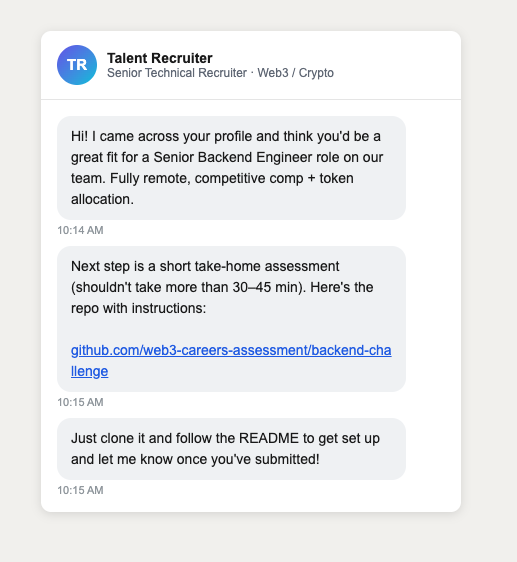
It starts with a message like this:
 A competitive salary, a remote role, maybe a token allocation thrown in for flavor. Nothing about it looks unusual; this is exactly how real recruiting outreach reads. The next step is where it turns: a GitHub repo with a short technical assessment, and instructions that boil down to “clone it, run npm install, and you’re set up.”
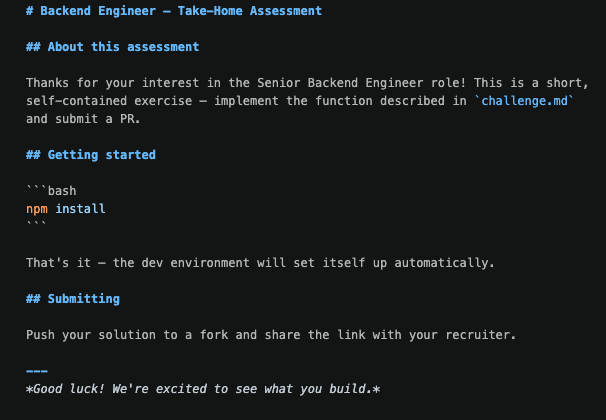
That one npm install is the whole attack. Node automatically runs whatever’s defined in a package’s postinstall script the moment dependencies are installed. No prompt, no confirmation, before the victim has even opened a single file of the actual coding challenge.
What a real payload does instead
In documented TraderTraitor campaigns, this exact mechanism, a script quietly run during setup, has been used to:
- Harvest browser session cookies and active login tokens, which the FBI says was the specific technique used in the DMM Bitcoin theft to impersonate an employee and manipulate a transaction
- Pull SSH keys and cloud credentials out of local config files
- Establish persistence, so the access survives long after the “interview process” ends
- Quietly map what the compromised machine can reach, cloud consoles, internal tools, CI/CD pipelines
None of that requires the victim to do anything more than what a completely normal onboarding step asks of them.
Why this works, even against a company the size of Binance
A $6.3 billion theft didn’t require breaking cryptography or finding a flaw in a smart contract. By Binance’s own account, it may have started with a single compromised laptop giving access to a system that could request withdrawals. The expensive, sophisticated-sounding part of this attack, the part that moved billions across ten blockchains in minutes, happened after the easy part: one convincing message, to one person, asking them to run one command.
What actually helps
- Treat unsolicited recruiter contact bundled with a “coding test” as inherently suspicious. especially one that asks you to run setup scripts before you’ve even seen the actual problem.
- Read before you run. Check package.json for postinstall, preinstall, and similar hooks before installing anything from an unfamiliar repo.
- No engineering workstation should have a path to production signing or withdrawal systems. Segment hard. A compromised laptop should be a dead end, not a way in.
- Phishing-resistant MFA and short-lived, device-bound sessions. A stolen session cookie should be close to worthless off the device it was issued to.
- Give engineers a fast, blame-free way to flag a suspicious “opportunity.” The entire chain depends on nobody pausing to ask a second question.
If this is new to you, it’s worth remembering: the most expensive hack in crypto history may have started with something as mundane as a LinkedIn message.